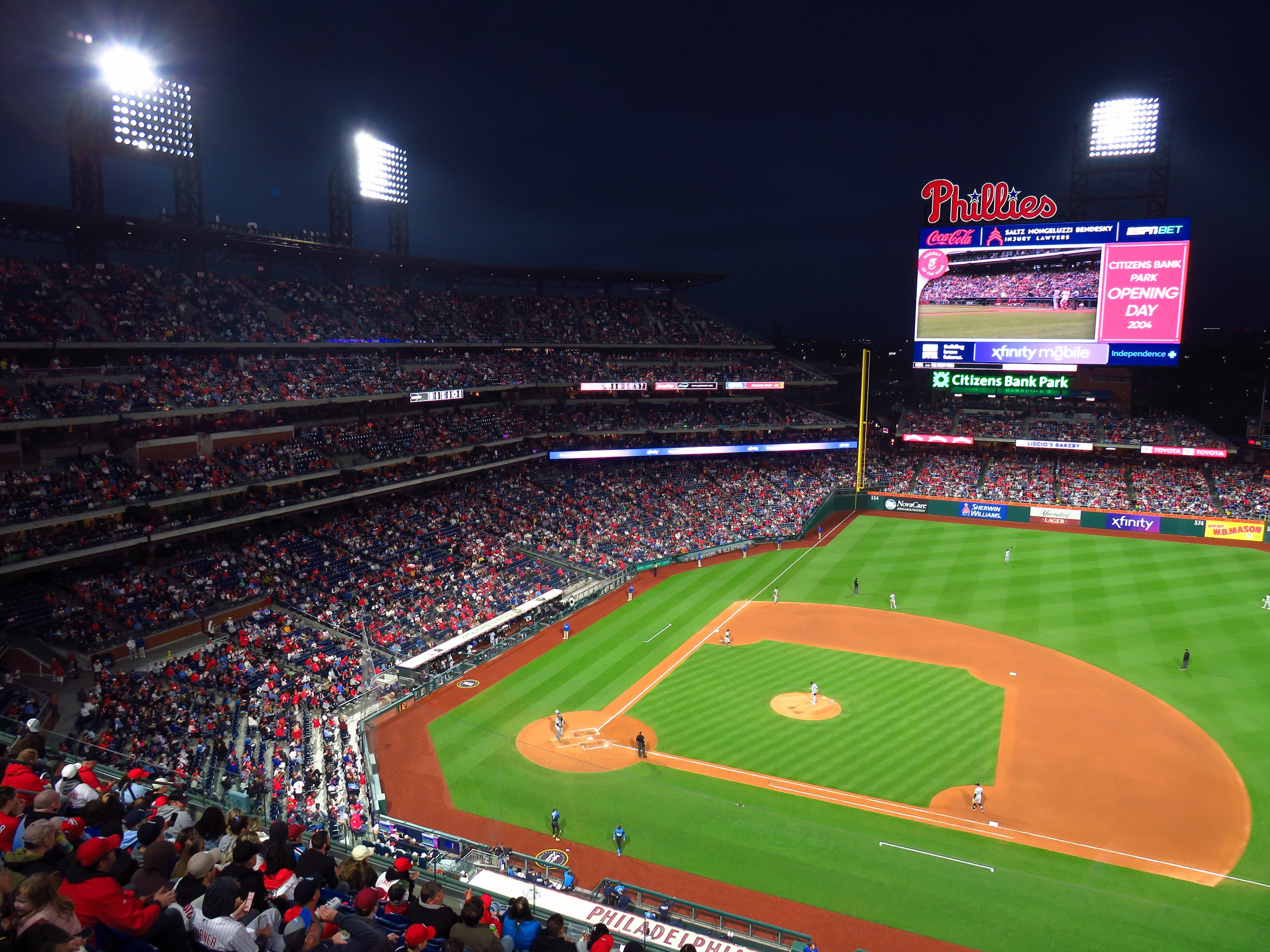
 Photo by Caleb Spicer, CC BY 4.0, via Wikimedia Commons
Atlanta Hosts Either Way
Four games in Philadelphia this weekend will be covered as a referendum on where Atlanta opens October. They do not decide it, and the team that might is playing in Chicago.
There is a number that could decide where Atlanta opens October, and it does not belong to Atlanta.
It is 78-61. It belongs to the Chicago Cubs, and it has been almost entirely absent from four days of Braves conversation.
That conversation has been about Philadelphia, which is reasonable. Atlanta finishes in Washington this afternoon at 1:05 with Holmes opposite Kent, takes Thursday off, and then plays four games in four days at Citizens Bank Park: Friday at 6:40, Saturday at 6:05, Sunday at 1:10 on NBC, and Monday at 1:05 on Labor Day. Probable starters are announced for all four already, which is a courtesy the schedule does not always extend three days out. Sale and Sanchez. Perez and Wheeler. Mahle and Nola. Elder and Luzardo.
Atlanta leads the National League East by 3.0 games. Philadelphia has won six in a row and 15 of its last 17. The series has the shape of a hinge, and it is being covered as one.
It is a hinge. It is not the hinge everyone is describing.
The rule, stated once
Baseball's bracket seeds the three division winners 1 through 3 by record and the three wild cards 4 through 6. The top two seeds get first-round byes. The 3 seed plays the 6, the 4 seed plays the 5, best-of-three, and every game of a Wild Card Series is played in the higher seed's park. All three of them. No split arrangement, no alternating venue, nothing to negotiate.
Which means the 3 seed hosts and the 4 seed hosts. That is the part the framing keeps dropping on the floor.
Atlanta at 82-57 is the 3 seed, the division winner with the third-best record, behind Milwaukee at 86-53 and the Dodgers, who at 82-56 own the same number of wins and a better winning percentage. Win the East and Atlanta hosts. Lose the East to Philadelphia, finish as the top wild card, and Atlanta is the 4 seed. Atlanta still hosts.
The only door to a road Wild Card Series is the 5 seed, and Atlanta cannot walk through it by losing to Philadelphia. It has to lose to Philadelphia and to Chicago.
Jim Salisbury laid the stakes out correctly for the Phillies in NBC Sports Philadelphia: win the division or take the top wild card and Philadelphia hosts; finish second in either race and it travels. That is true. It is true because Philadelphia is already the 4 seed, and from the 4 seed every remaining direction is down. Mirror the sentence onto Atlanta and it stops being true. Atlanta is standing on the other side of the same rule.
The third body
Chicago is 78-61, four games behind Atlanta and one behind Philadelphia. Until Tuesday night the Cubs held the top wild card. The Phillies took it from them with a 7-1 win at Arizona on an evening when Chicago lost and Atlanta lost 9-5 in Washington, which is the tidiest kind of gain there is: two races moved and Philadelphia only played in one of them.
ESPN's playoff tracker, updated at 6:30 Wednesday morning, prints the bracket the rule produces: Padres at Braves, Cubs at Phillies. Read the prepositions. Both series sit in the higher seed's park, and Atlanta and Philadelphia are both the higher seed. Twenty-four hours earlier the two clubs behind that second line were the other way around. The names moved. The preposition did not.
So the four games are not a referendum. They are the first of two conditions, and the second condition is a team in the Central that has gone almost entirely unmentioned in this city all week.
Atlanta does get a say in it, and it comes late. Three games at Wrigley Field on September 14, 15 and 16 are the only meetings the two clubs have left, and they begin the day after Atlanta's last Philadelphia game of the season. Hold the division and those three nights are a scheduling detail. Lose the division and they are the closest thing to a play-in this season is going to offer.
There's a version of this season where Atlanta loses all four in Philadelphia, loses the East, edges the Cubs by half a game, and hosts the Cubs in the Wild Card Series anyway.
What four games actually decide
They decide the division. The magic number there is 21, which is arithmetic rather than opinion: 163, minus Atlanta's 82 wins, minus Philadelphia's 60 losses. There are 23 games left. Seven of them are against Philadelphia — these four and three more at Truist Park the following weekend — and three are against Chicago.
They decide the opponent. The 3 seed draws the 6, which today is San Diego at 73-66. The 4 seed draws the 5, which today is Chicago. Those are different assignments, and choosing between them is a real prize, just not the one on the marquee.
And they decide whether Atlanta needs anyone's cooperation at all.
What they do not decide is participation. ESPN's model puts Atlanta above 99.9% to reach the postseason and Philadelphia at 99.6%. Nobody in that building this weekend is playing for a ticket. They are playing for the order of names on a bracket, which is a smaller thing than it will feel like Friday night and a larger thing than it sounds when you say it flatly.
The building
I put this in print yesterday and it has not aged: the home-road split is the part that should hold your attention. Atlanta is 48-24 at home and 34-33 on the road. The second number moved Tuesday.
The gap is .159 in winning percentage, .667 at home against .507 on the road. Across all 30 clubs that ranks third, behind Miami and Kansas City. Among the 12 teams currently holding a playoff position, by Tilt's calculation from ESPN's splits Wednesday morning, it is the largest.
Philadelphia is built the other way. The Phillies are 38-30 at home and 41-30 on the road, marginally better away from home all season, which is the rarer condition and the more useful one.
Two clubs will spend four days in one ballpark. One of them has spent five months demonstrating that where it plays changes what it is. The other has spent five months demonstrating that it doesn't. The venue is worth more to the visitors than to the hosts, and it isn't close.
One further piece of that, offered because it cuts against the argument rather than for it: Luzardo, who starts Monday's finale opposite Elder, carries a 3.02 ERA that NBC Sports Philadelphia reports as seventh-best in the National League, and he is 9-0 in 15 road starts this year. He does not get to use that split. He is home.
The honest part
Atlanta arrives cold. Two straight losses, a road record that got worse Tuesday, and a full game of division cushion surrendered without playing Philadelphia once. The Phillies arrive having gone 21-7 in August, the best record in baseball for the month, and six straight wins inside a nine-game road trip.
That is the evidence, and the evidence supports a seeding argument, not a prophecy. Four games in early September do not settle a 162-game season, and these four will not even settle the question they are being asked about.
By Monday night Atlanta will know a great deal about the National League East and almost nothing about where it opens October. That answer is being written in two cities. Only one of them is on the schedule this weekend.
The Tilt
The Cubs matter more to where Atlanta opens October than the Phillies do.
— Ellis Magnolia
What's your take?
Ellis Magnolia
Numbers & narrative — statistical depth worn lightly, literary pacing.
Keep Reading
Atlanta Went Looking for a Slight
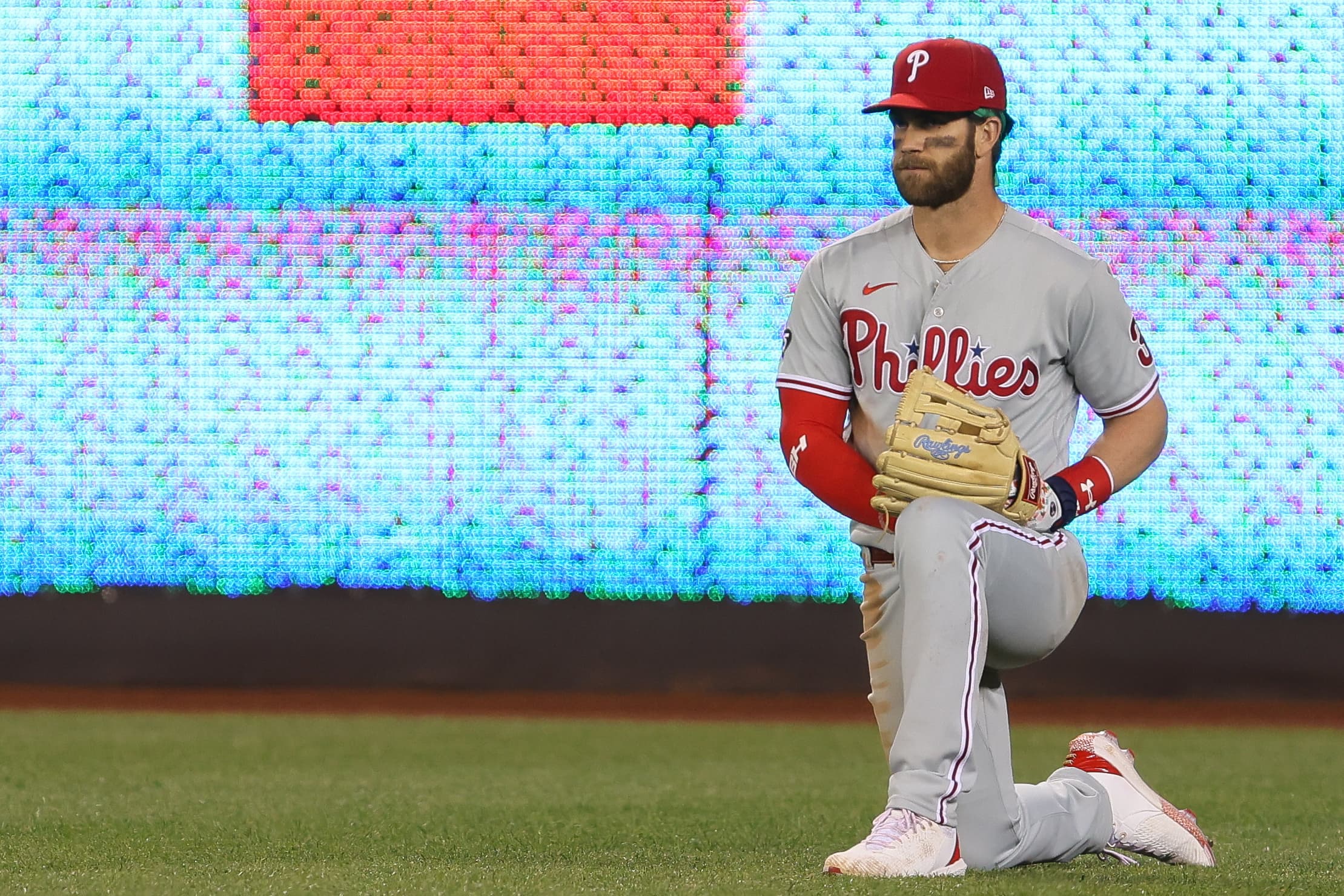
Bryce Harper called the Braves really good, and a chunk of this city is going to hear an insult anyway. That says nothing about him and everything about us.
.jpg&w=3840&q=75)
Three First Times
Three men played their first major league game Tuesday night in Washington, and two of them beat the Braves. The fourth young arm in the game belonged to Atlanta, and his ERA is now 7.13.
Two Outs, Runners On
The Braves traded Anthony Molina to San Francisco a month ago. Monday night he came back and ended their seven-game winning streak, four days before the pitcher they traded him for starts in Philadelphia.