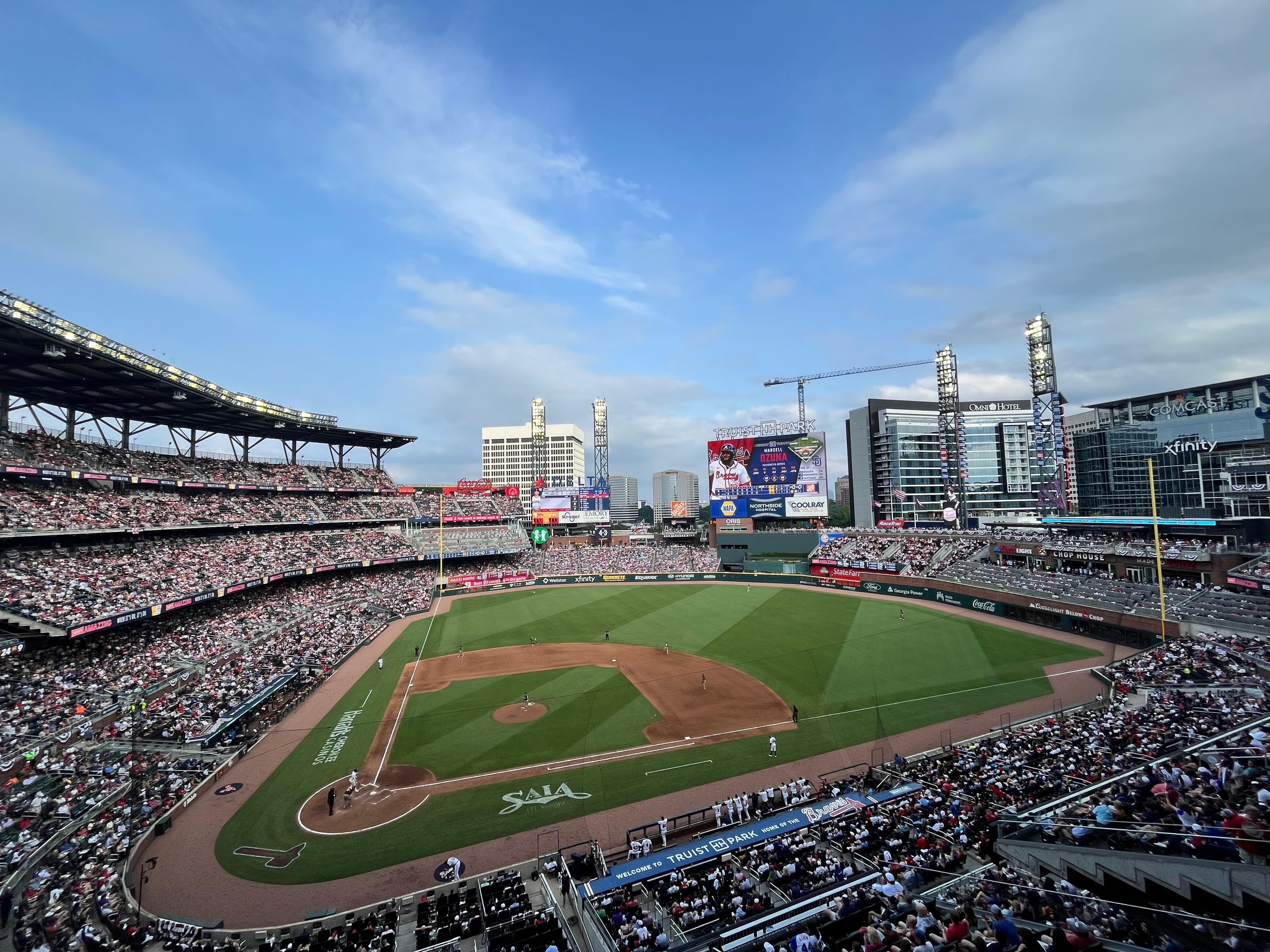
.jpg&w=3840&q=75) Photo by Uncivil Engineer, CC BY-SA 2.0, via Wikimedia Commons
Photo by Uncivil Engineer, CC BY-SA 2.0, via Wikimedia CommonsForty-Eight Hours and the Catcher Nobody Planned For
The Braves' best center fielder was out, their third catcher in two weeks was making his debut, and their ace threw his quietest start since returning. They won anyway, which is what 44-21 teams do.
Forty-eight hours.
That is how long Austin Wynns had been an Atlanta Brave before he crouched behind home plate at Truist Park and caught Spencer Strider on a Saturday night in June. Acquired from the Angels for cash considerations on Thursday — the same day Drake Baldwin went to the injured list with an oblique strain and two weeks after Sean Murphy fractured his left middle finger — Wynns did not need to be excellent. He needed to exist.
He went 0-for-4 at the plate and the Braves won 6-3 over Pittsburgh, which tells you most of what you need to know about where this team finds its margin.
The margin, on this night, belonged to Dominic Smith.
Smith's two-run homer in the first inning — inside the left-field foul pole, the kind of shot that makes you hold your breath before the umpire signals fair — staked the Braves to an early lead they would not relinquish. It was his second hit of a 2-for-3 evening with a walk, the continuation of a story that stopped making sense in March and has refused to start making sense since. He signed a minor-league deal. He hit a grand slam on Opening Day. His mother had died two weeks before that. He is still here, still producing, on a contract that was designed to be organizational depth and has instead become something more stubborn than that.
Strider, for his part, was workmanlike and nothing more. Five innings, five hits, three earned runs, two walks, three strikeouts. The strikeout number is the one that lingers. This is a pitcher with a career 11-plus strikeouts per nine innings, a pitcher whose entire reinvention — the velocity recalibration from 97 to 94, the rising spin rates that I detailed in this morning's piece — is premised on the idea that he can miss bats without missing locations. Three strikeouts in five innings is not the profile. It is not alarming after one start. It is worth one sentence in the notebook and a longer look at the next outing.
The record moved to 4-1. The ERA remains in the mid-threes. The win column does not distinguish between dominant and adequate, which is a mercy Strider has earned.
Around Strider's adequate evening, the lineup did what deep lineups do. Ronald Acuna Jr. went 2-for-4 with two runs scored. Mauricio Dubon — whose three-game homer streak ended with a quiet 2-for-4 — still managed to score twice. Austin Riley doubled home a run in a 2-for-4 evening. Ozzie Albies drove in two on an 0-for-1 night, which is the kind of productive out that does not photograph well but wins games.
And then the bullpen corridor opened. Dylan Dodd struck out three in a hitless inning. Dylan Lee struck out two more. Tyler Kinley worked around two hits. Raisel Iglesias closed the ninth for his thirty-first consecutive save conversion — a streak that has become so routine it barely registers as a streak at all. Four relievers, four innings, zero earned runs, seven strikeouts. The bridge from starter to closer has become the most reliable infrastructure in the National League.
The box score will record this as a routine win over a team the Braves should beat. The roster page tells a more interesting story. Michael Harris II was out of the lineup, day-to-day with what Walt Weiss called a "very short-term" issue. Baldwin is on the injured list. Murphy is on the sixty-day injured list and will not return until after the All-Star break. Tromp was designated for assignment on Thursday. The catching carousel has spun from Baldwin to Murphy to Tromp to Wynns in the space of a month, and the Braves have not lost a step — because the step was never about who was catching. It was about the pitching staff he was catching for, and the lineup that was scoring around him.
I wrote on June 1 that Alex Anthopoulos would trade for a catcher before the deadline. Wynns is not that trade. Wynns is the patch that buys time until the trade, the organizational reflex of a front office that replaces parts faster than parts break. The prediction stands. The timeline just got longer.
Forty-four and twenty-one. The catcher is new. The center fielder is resting. The ace's strikeout rate dipped. The closer's save streak did not.
The Tilt
The catching crisis isn't a crisis. It's a roster replacing parts faster than they break.
— Ellis Magnolia
What's your take?
Ellis Magnolia
Numbers & narrative — statistical depth worn lightly, literary pacing.
Keep Reading
FanSided Wrote a Warning About the Braves Using Their Own Best Argument Against Themselves
FanSided spent an entire column warning you not to trust the best team in baseball. Their own evidence proves them wrong.
_14_Chris_Sale.jpg&w=3840&q=75)
Good Numbers, Better Architecture
FanSided published their counter-argument this week, and the data they cited is real. The question is whether they read it correctly.
_(51101555196).png&w=3840&q=75)
One Team, Four Pillars, and the FIP That Ends the Argument
Bleacher Report named the Braves the only team built to beat the Dodgers. The FIP column says they might be right.