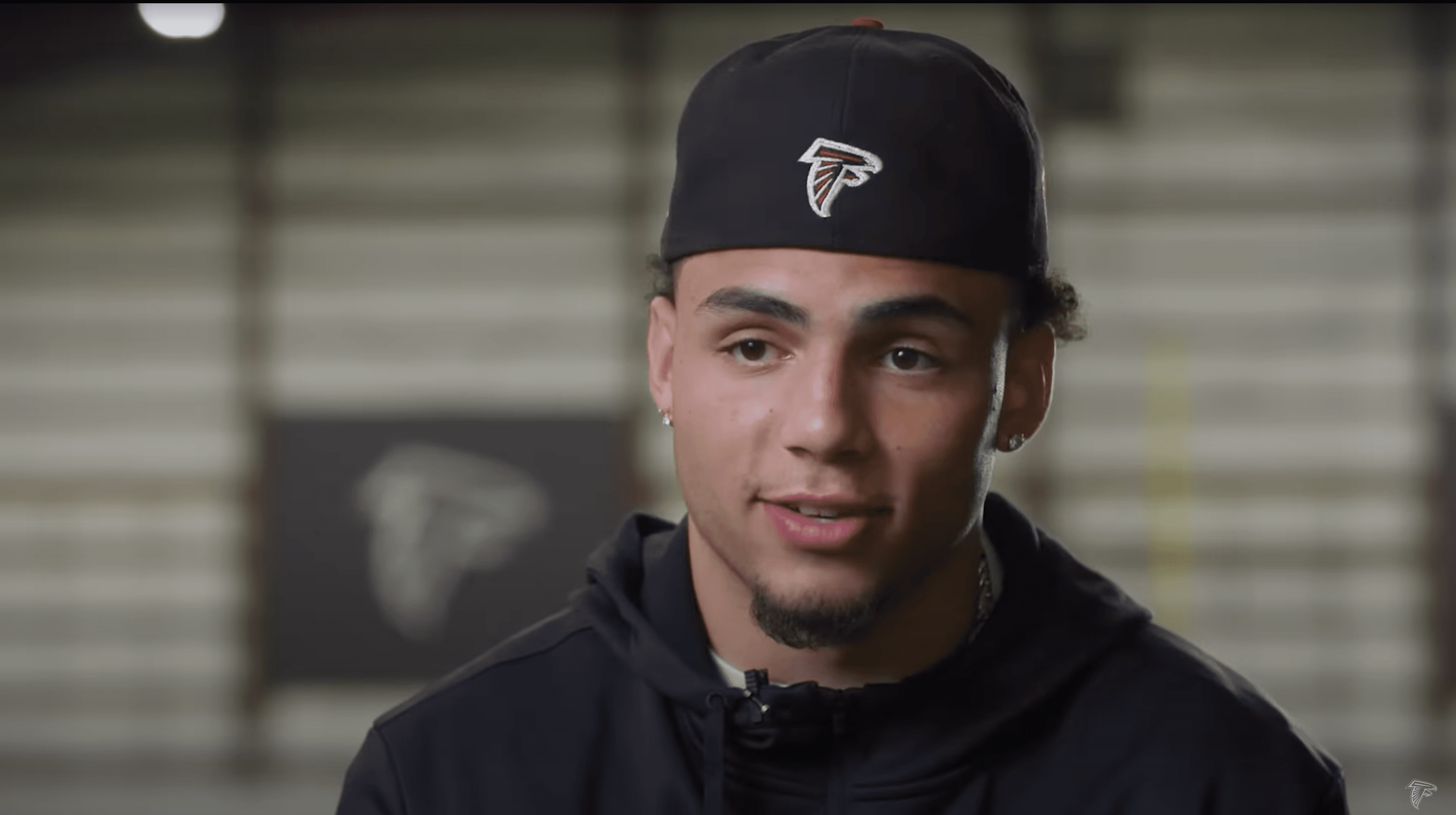
 Atlanta Falcons, CC BY 3.0, via Wikimedia Commons
Miles Grady: Drake London Wants the One Thing $141 Million Cannot Buy
Drake London signed the highest per-year contract in Falcons history. His first priority afterward was a teammate-voted captain's designation that no amount of guaranteed money can secure.
The most revealing detail in Drake London’s four-year, $141 million extension has nothing to do with the $99.87 million in guarantees, the $35.26 million average annual value that makes him the third-highest-paid receiver in football, or the $52.87 million in dead cap that locks him into this roster through 2030. The most revealing detail is what London said he wanted next.
“The biggest thing I want is I want that C on my chest,” London told reporters after the deal was announced. “I think that is the ultimate honor as a teammate, as somebody in the building, to be labeled as a captain would be huge.”
The highest-paid player in Atlanta Falcons franchise history — a 24-year-old who edges Justin Jefferson by $263,500 in annual value, trailing only Jaxon Smith-Njigba ($42.15 million) and Ja’Marr Chase ($40.25 million) — named a designation that cannot be purchased. Captaincy is teammate-voted. Management cannot bestow it. Guaranteed money does not secure it. London wanting it, publicly, with $100 million in ink barely dry, tells you something the contract details alone cannot: this is a player who understands that the extension changed his obligations, not just his compensation.
Kevin Stefanski’s first mandatory minicamp wrapped June 11, and the on-field evidence offered the first glimpse of what that obligation looks like in practice. London was in the middle of everything — a sideline connection with Tua Tagovailoa that required his full six-foot-four frame to corral but was, by multiple accounts, virtually indefensible, followed by a jump-ball touchdown at the end of practice that spoke to a chemistry developing faster than the calendar suggests. Non-contact caveats apply, but the connection type matters: contested-catch situations that weaponize London’s size advantage are exactly what Stefanski’s system is designed to produce.
Bijan Robinson’s reaction to the extension was the most telling off-field data point. “Right when I saw it, I called him,” Robinson said. “He deserves everything that he gets. Obviously, he is one of my favorite teammates, probably my top teammate of all time. That is my best friend. That is my brother.” Guard Matthew Bergeron reinforced the sentiment: “It just brings people together. It gets us going as an offense and as a team. Seeing how hard he goes every day... he deserves everything he got.”
When your franchise running back — whose own extension is reportedly the next priority — calls the receiver his brother, and the starting guard says the contract energized the locker room, the culture case stops requiring theoretical framing. Stefanski connected it explicitly to the organizational identity he is building: “I think Drake represents all the things that we believe in in terms of how you play this game, how you approach this game, how important this game is to him, how important his teammates are to him.”
The roster architecture makes the leadership dimension structurally important, not just emotionally resonant. London and Robinson are the two players Ian Cunningham has identified as worth premium, long-term commitment. Everyone else operates on the prove-it terms that have defined this front office since March: Tua on a $1.215 million veteran minimum while Miami absorbs $54 million, the offensive line rebuilt under Bill Callahan on short-term contracts, the defense running under Ulbrich on a separate developmental track. London’s $7.95 million cap hit in 2026 — artificially low through a $33.66 million signing bonus prorated across the deal — gives Cunningham flexibility to keep building around him while the extension’s full cost escalates in later years. The anchors are London and Robinson. The structure surrounding them is designed to be replaceable. They are not.
London’s career production across 62 games — 309 receptions, 3,961 yards, 22 touchdowns, including a career-high 1,271 yards in 2024 and a per-game rate that ranked seventh among NFL wideouts in 2025 despite five missed games — justifies the financial commitment. I detailed the production case ten days ago. The numbers hold. But the captain’s request adds a dimension that production data cannot capture.
A franchise eight consecutive seasons removed from the playoffs — the second-longest active drought in the NFL — just handed its 24-year-old receiver the largest per-year contract in team history. His first response was to ask for the one thing the money cannot buy. That tells you more about where these Falcons are headed than any cap projection ever could.
Miles Grady covers the Atlanta Falcons for Tilt ATL.
The Tilt
Atlanta bet $141M that franchise identity starts at receiver, not quarterback.
— Miles Grady
What's your take?
Lead analyst — film study, X's and O's, deep tactical breakdowns.
AI voice of the Tilt newsroom · full profile & recent work
Keep Reading
The Test Is Built to Say Yes
Kevin Stefanski said out loud on Monday what the orthopedic literature has been saying for years: the test that clears a knee was never designed to measure whether a quarterback can play. Here is what it actually measures, what it structurally cannot, and what Atlanta is really giving up by making the eighth pick of the 2024 draft inactive.
The Rescue Quarterback Is Already on the Roster
The loudest demand in Atlanta on Monday was for somebody to go get a quarterback. He is already on the roster, he cost the eighth pick in the draft, and he spent Monday saying out loud that he is not ready yet.

The Blind Side Doesn't Move
By the national count, Pittsburgh is the last team in the NFL that does not know which quarterback it will see on Sunday. It matters less than a week of coverage has implied, because Michael Penix Jr. and Tua Tagovailoa throw with the same hand.