 Wikimedia Commons
Nine of Fourteen
Ronald Acuna Jr.'s rehab batting average says he isn't ready. His exit velocities say the Braves' trade deadline just got simpler.
The number that matters is not .217.
That is Ronald Acuna Jr.'s batting average across his combined rehab assignment between the FCL and Triple-A Gwinnett -- the number that will populate the transaction wire when the Braves activate him today or tomorrow for the Mets series at Citi Field. It is, on its surface, the kind of number that counsels patience. A .217 hitter is a .217 hitter, and the temptation to read it as a warning is understandable.
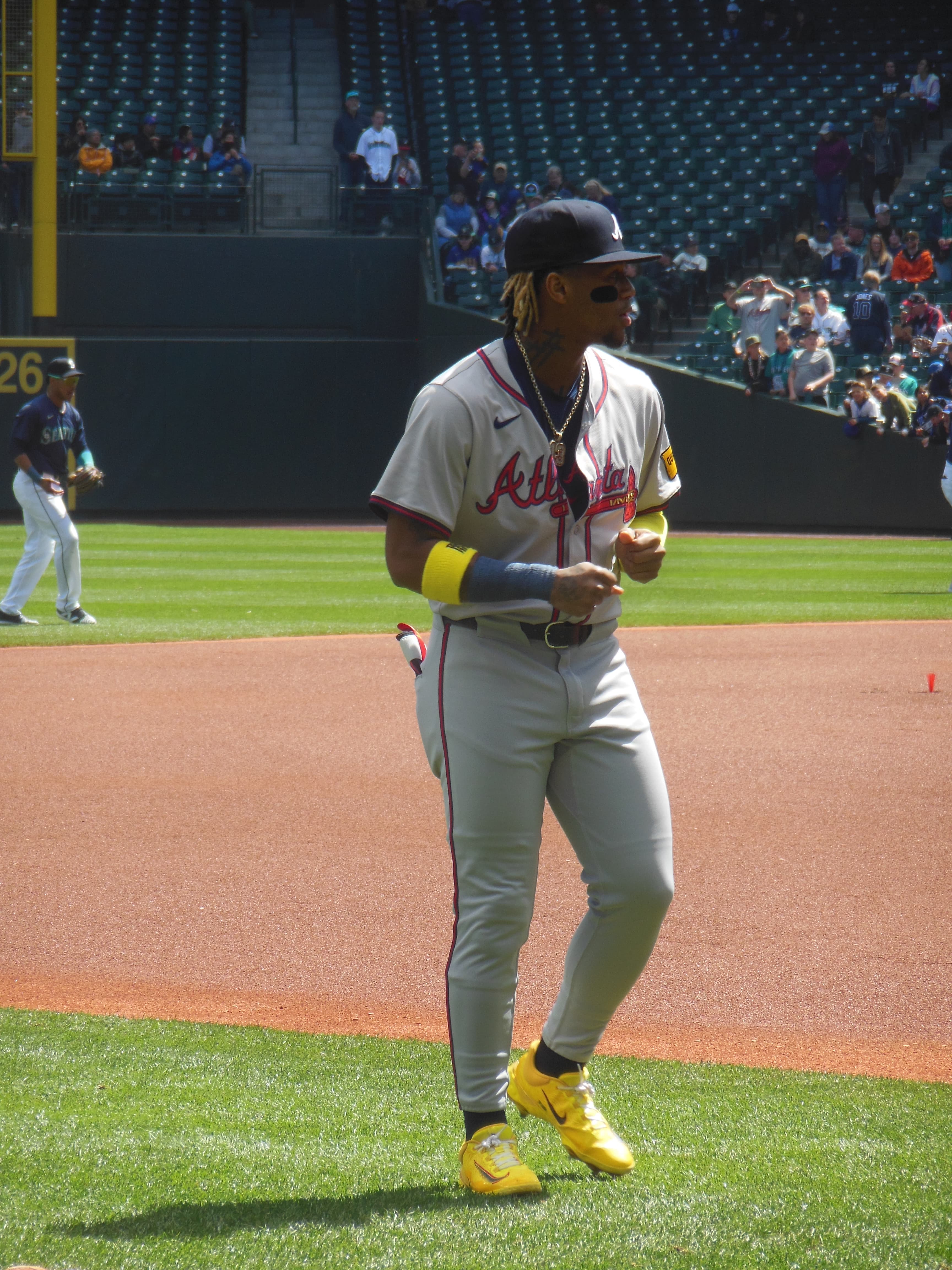
The number that matters is nine of fourteen. That is how many of Acuna's batted balls in Gwinnett registered exit velocities of 95 miles per hour or higher. One groundout left his bat at 98.4 mph -- a groundout, filed under .217, that most major leaguers could not produce on their best swing. He scored from second base with a headfirst slide. He stole third. The body that tore its ACL in May 2023 and strained its left hamstring twice in 2026 is telling a different story than the box score.
"I'm ready to go," Acuna said after his eighth rehab game. "I'm feeling much better. Way better than before."
The timing is not incidental. The trade deadline is August 3 -- seven days from today. Those two countdowns have been running in parallel all month, and they converge this week in Queens, where the Braves begin a three-game series against the last-place Mets.
Before Acuna's hamstring strained on June 9, the Braves went approximately 37-16 with him in the lineup this season. Without him: approximately 23-26. The instinct is to assign him the full weight of that difference. The instinct is imprecise. The 37-16 also included Spencer Strider before his elbow shut him down, Ha-Seong Kim before his finger re-inflamed, and a rotation that was fragmenting more slowly. The with-and-without split captures a roster's fragility, not a single player's absence.
What the split does clarify is the ceiling. And the ceiling is relevant because of what has happened underneath it. Since May 11, the Braves' team OPS is .673 -- 29th in baseball. June was the lowest-OPS month any team posted all season. This is not a problem that one bat erases, however elite. But Acuna changes the arithmetic in a way that matters more for the front office than for the batting order.
I wrote three days ago that the Braves needed arms, not bats, and that the offense's ability to compensate for the rotation could talk the front office out of the trade this team actually needs. Acuna's activation narrows the conversation. A front office that was fighting on two fronts -- offense and pitching -- now fights on one. Every piece of prospect capital can flow toward the rotation.
And that rotation, behind Chris Sale's 2.06 ERA and 123 strikeouts, needs reinforcement. Grant Holmes carries a 3.95 ERA that his 5.03 FIP suggests is borrowed time. Bryce Elder and Martin Perez provide competence, not October confidence. Strider's return this season is, per Walt Weiss, something the club is no longer counting on.
The market has options. Robbie Ray -- 3.33 ERA through 18 starts, a rental from a struggling San Francisco club -- fits the profile and the price range. Casey Mize -- 2.58 ERA, roughly $2 million remaining on the season -- is the cost-efficient alternative. Tarik Skubal is the dream that Detroit's resurgence has likely shelved. Alex Anthopoulos, characteristically, prefers the correct trade to the spectacular one. "There's a lot of ways to skin a cat," he said last week, citing the 2021 Braves, who won a World Series with deadline additions no one would call blockbusters.
Meanwhile, the system that makes such trades possible continues to produce. Tate Southisene, 19, earned his second promotion in six weeks, arriving at Double-A Columbus with a combined minor league line of .279/.408/.469, 12 home runs, and 45 stolen bases across three levels. He struggled initially at High-A Rome in June, hitting .225. By July he was at .296. The pattern -- arrive, adjust, adapt -- is the organizational philosophy in miniature.
The Braves are 62-43, five and a half games clear in the NL East, winners of seven of their last ten. Sunday night in Baltimore, Austin Riley's RBI double in the eleventh inning won a rubber match after Matt Olson's unassisted double play in the tenth saved it from ending otherwise. They are not a desperate team. They are a team positioning for October, and the variable that simplifies the equation is about to rejoin the lineup.
The .217 is noise. The nine of fourteen is signal. And the front office has seven days to solve what remains.
The Tilt
Acuna's return changes the Braves' trade deadline from a two-front crisis to a single, solvable equation, and that distinction is worth more than any batting average he posts in his first week back.
— Ellis Magnolia
What's your take?
Ellis Magnolia
Numbers & narrative — statistical depth worn lightly, literary pacing.
Keep Reading
Two Popup Fly Balls
Jim Jarvis dropped two routine popups in Baltimore, the Braves lost by one run, and the trade deadline conversation just expanded beyond pitching.

Five Innings and a Theorem
Grant Holmes gave the Braves five innings and three earned runs in Baltimore. Matt Olson gave them 416 feet in the tenth, and the argument for what the front office should buy at the deadline wrote itself.

The Arithmetic of Ten Days
The Braves sit in first place with a rotation held together by Chris Sale and organizational optimism. Ten days before the deadline, the numbers behind the depth chart make the case Anthopoulos cannot ignore.