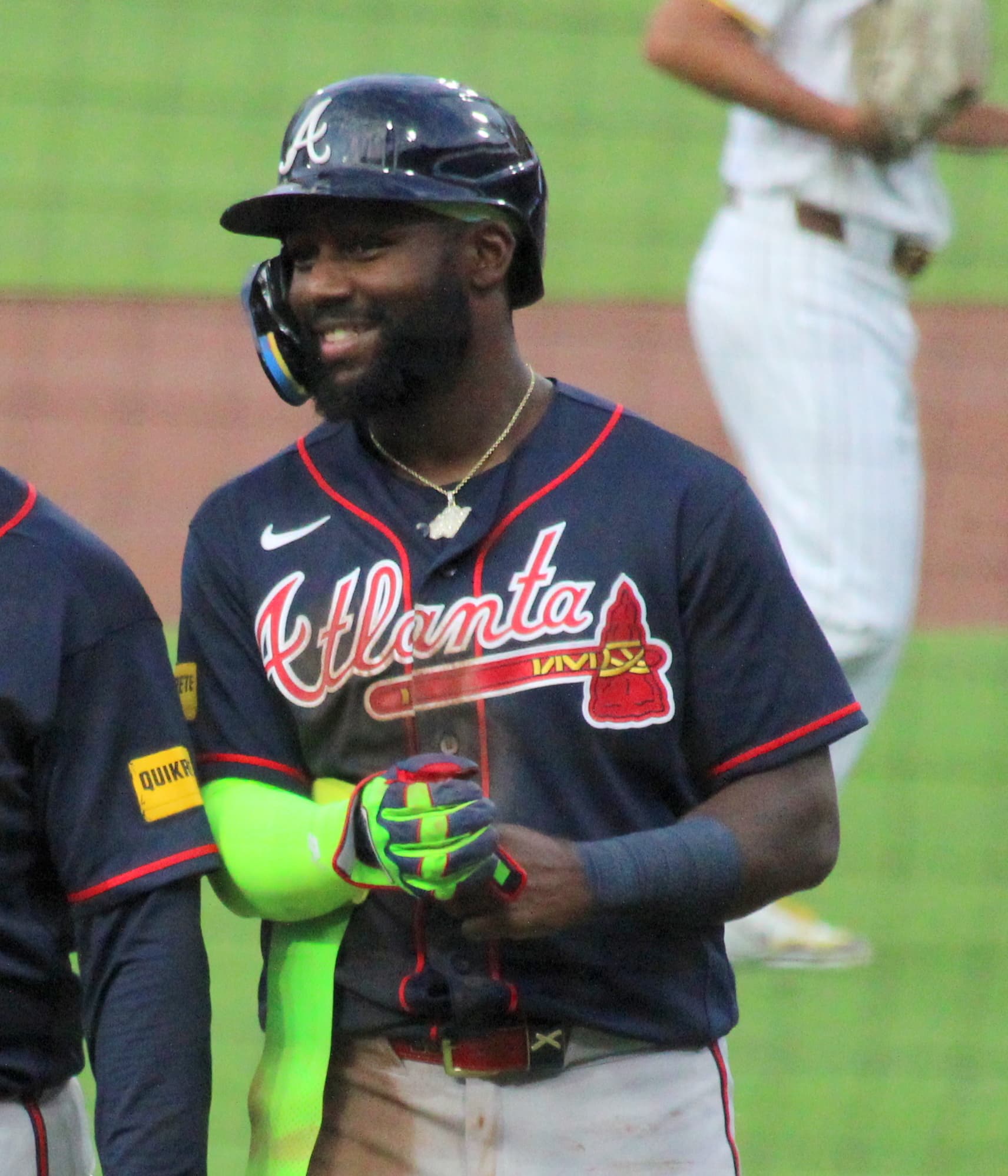
_(cropped).jpg&w=3840&q=75) Photo by Minda Haas Kuhlmann, CC BY 2.0, via Wikimedia Commons
Photo by Minda Haas Kuhlmann, CC BY 2.0, via Wikimedia CommonsEllis Magnolia: The Rearview and the Windshield
The broadcast graphic will show Sasaki's ERA in the high fours and Smith-Shawver's north of six. Both numbers are lying, in opposite directions.
Roki Sasaki will bring a season ERA in the high fours to the mound tonight at Truist Park. AJ Smith-Shawver will bring one north of six. On paper, this looks like a matchup between two pitchers fighting through difficult seasons — the mediocre against the overwhelmed.
Paper does not throw pitches.
Sasaki's number is a fossil. The preserved record of a first half that no longer represents the pitcher standing on the rubber. Before the All-Star break, his ERA sat above 5.00, the kind of figure that makes you check the name twice. Since? Roughly a 2.3 ERA over his last six starts, including 5.2 scoreless innings against the Yankees, a nine-strikeout, one-run effort against the Mets, and a six-strikeout, two-run outing at Colorado on August 19. The season number is a rearview mirror describing January through June. The six-start number is the windshield.
Smith-Shawver's ERA tells a different kind of untruth. His is not a large-sample disguise but a small-sample costume — there is barely enough pitcher underneath the number to evaluate. Two MLB starts since returning from a Tommy John rehab window. The Braves moved to a temporary six-man rotation just to manage his workload. His most recent outing, also August 19, against Minnesota: four earned runs on five hits and three walks in four and a third innings. The number north of six looks alarming. It is also two outings doing the work of a season. If you have ever tried to draw a trend line through two points, you understand the limitation.
This is tonight's Game 2: a pitcher whose season ERA understates his current form against a pitcher whose season ERA overstates everything because there is almost nothing to state.
### By the Numbers
The Braves won Game 1 last night, 4-3, but the final score compresses a game that had a more complicated shape. Atlanta built a 3-0 first-inning lead, watched Los Angeles — led by Alex Call's two-hit, one-RBI night — claw it back to 3-3 by the fourth, and didn't score again until the eighth. That run came off Ozzie Albies's bat: a go-ahead single that capped a 2-for-4, two-RBI evening. Albies was the only Brave to produce multiple hits in a game that rewarded patience more than force.
Tonight's margin will likely be measured differently. Sasaki, in his current six-start form, is capable of the kind of outing that makes the Dodgers' pitching advantage operational — not theoretical, but demonstrated. Smith-Shawver, two starts into his return, is capable of anything from four clean innings to four complicated ones. The small sample that makes his ERA unreliable cuts in both directions.
### The Larger Ledger
The Braves are 77-55. The Dodgers are 80-52. Los Angeles holds the better overall NL record, which means the Dodgers are tracking toward a top playoff seed independent of what happens in this series. But if the Braves take two of three — and last night's result puts them one win away — Atlanta owns the head-to-head season-series tiebreaker against L.A. That matters only if the two clubs end up tied in the loss column when October seeding is finalized. A scenario worth understanding, not a guarantee worth banking.
As Dex noted last night, the Dodgers arrived at Truist Park carrying a six-game win streak and the posture of a team testing credentials. Game 1 was the first response. Game 2 asks a different question — not whether the Braves can survive a one-run margin against Los Angeles, but whether a twenty-three-year-old making his second start since surgery can hold the line against a pitcher who has spent six weeks remembering what his arm was built for.
There is a version of tonight where the number after Smith-Shawver's name looks respectable by the fifth inning — where the stuff that made him a top prospect before the surgery reasserts itself under October-adjacent pressure. There is another version where the Minnesota start was more representative than hopeful Braves fans want it to be. Both remain equally plausible on a sample of two. That is the definition of insufficient evidence wearing an ERA.
Sasaki has earned the right to be expected to pitch well. Six starts of sub-2.3 work is not a contract, but it is a trend the Dodgers have reason to trust. The season number in the high fours is an artifact of a different pitcher from a different month.
First pitch is 7:15 PM at Truist Park. The ERAs will be on the broadcast graphic. Read them with footnotes.
The Tilt
Trusting Smith-Shawver tonight means believing in the Braves' program more than two data points.
— Ellis Magnolia
What's your take?
Ellis Magnolia
Numbers & narrative — statistical depth worn lightly, literary pacing.
Keep Reading

Ellis Magnolia: Six and Five
The morning's thesis was eighty-three runs. The evening's proof was one.

One Down. Ask Me Again Thursday.
Ozzie Albies singled home the go-ahead run in the eighth inning, and Raisel Iglesias stranded Shohei Ohtani at third to close it. Game 1 answered. Two to go.
Three Games and Eighty-Three Runs
The Phillies have closed a 9.5-game deficit to three in a month. The Braves' 83-run advantage in run differential suggests the math hasn't moved nearly as far as the scoreboard.