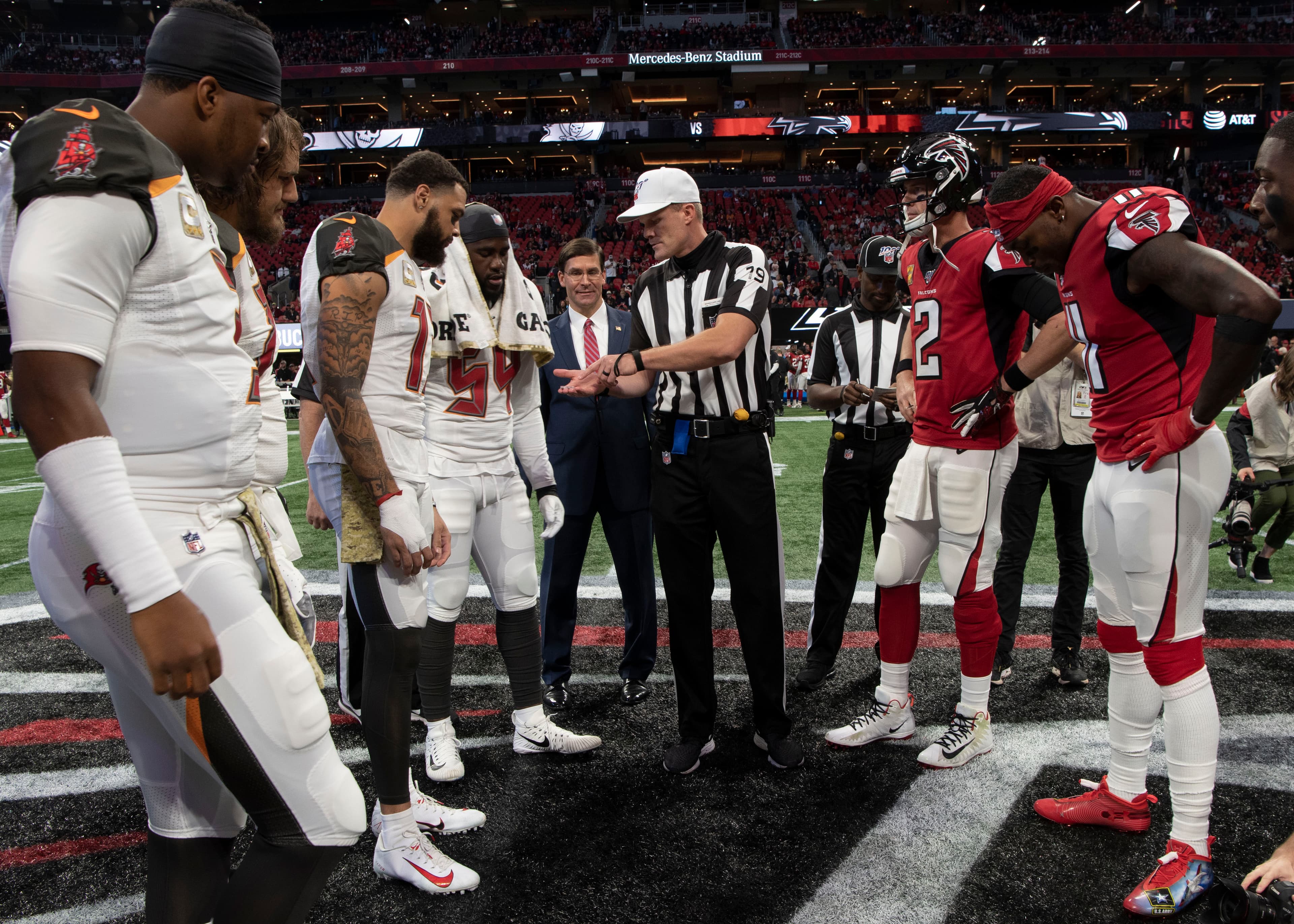
 Photo by Lisa Ferdinando on behalf of U.S. Secretary of Defense, Public domain, via Wikimedia Commons
The Room Changed Its Vote
Twelve months ago the Atlanta locker room voted Michael Penix Jr. a captain. On Thursday the same room voted again, handed the patch to a running back, a guard, a safety, a linebacker and a 41-year-old kicker, and gave one to no quarterback at all.
The Atlanta Falcons published their 2026 captains on Thursday afternoon, and the load-bearing words sit in the middle of the sentence, not at its end. Running back Bijan Robinson, guard Chris Lindstrom, safety Jessie Bates III, linebacker Divine Deablo and kicker Nick Folk "were voted on by the team to be the captains throughout the 2026 season," per the club's own release. Five names. A first-time honor for Robinson, Deablo and Folk. No quarterback.
The national coverage that followed made the club the actor. Pro Football Network's aggregation ran the reaction under an "Unserious Franchise" headline, on the premise that headline carries: an organization handing out patches before it has named a quarterback. The club's own sentence names a different actor. The players voted.
That correction is worth making once, and it is also worth not over-reading. The subhead on the same page reads "The organization has named five individuals to the honor," a different actor again -- and the body sentence is passive, with no agent. "Voted on by the team" does not say who counted the ballots or whether the coaching staff had input. Take the club at its word on the method and no further.
The same electorate, twelve months apart
If the players voted, the useful question is not who they picked this week. It is who they picked last September.
They picked six. Michael Penix Jr. was one of them -- in the club's own 2025 release, under the same words -- along with Lindstrom, offensive tackle Jake Matthews, Bates, and two players who are no longer on Atlanta's roster at all. Lindstrom and Bates were returned this week. The two who are gone from the roster are gone; their absence from the 2026 list means nothing.
Which leaves exactly two men who were captains in 2025, are still in this building in 2026, and were not re-elected. One is Penix. The other is Jake Matthews.
That comparison does not appear in any coverage of the announcement I could find, and it would not: it is a derivation -- mine -- built by setting the club's 2025 list beside Atlanta's current roster. A ballot that dropped a quarterback and a 34-year-old tackle in the same pass is not a referendum staged about a quarterback. It is a reshuffle in which the quarterback is the most conspicuous name involved.
The instrument is noisier than it looks, too. Lindstrom's captaincies, by the club's own accounting, are 2026, 2025 and 2023. He skips 2024. If a season without a patch meant something durable, this room unmeant it twelve months later, about the least controversial player on its roster.
What a captaincy actually confers
Here's what the rulebook hands a captain, and the list is far shorter than the noise around it.
Under Rule 18, a team may send up to six captains to midfield for the coin toss, one of whom is designated the speaking captain -- the only one who actually speaks. The visiting delegation calls heads or tails, and Atlanta is the visiting team when it opens at Pittsburgh on Sunday, September 13. During the game, the captain of the offended team chooses whether to accept or decline a penalty, except where enforcement is automatic by rule. An injured captain is replaced. That is the enumerated set. And the standard description of the role is blunt about the position everyone is arguing over: beyond those duties, the starting quarterback "has no other responsibility or authority on field."
The penalty option is the only real in-game decision on that list, and it is a genuine leverage call -- accept the hold and put them in third-and-15, or decline it and make them play fourth-and-5 -- taken in a few seconds, on the field, with no coach in the conversation. The rest is ceremony.
That is the whole point.
If the "C" carried operational authority, Thursday would be an administrative story about job titles. Because it carries almost none, the vote becomes something rarer: a signal that costs the people casting it nothing structurally. No player gains snaps, protection calls or standing by voting one way rather than another, which removes any strategic reason to vote dishonestly. It is the only clean, countable, one-person-one-vote instrument this locker room is handed all year, and it is worth reading precisely because it changes nothing about who runs the huddle.
Committee at the top, self-organization below
Look at the shape of the group and not only at the hole in it. Two of the five play offense: a running back and a guard. Neither is a designed target on a passing down. The offense's two elected voices are the man who carries the ball and the man who blocks for him.
The other three are a safety, a linebacker and a kicker in his 19th NFL season. The quarterbacks on this roster carry 9 years of NFL service (Cooper Rush), 7 (Tua Tagovailoa), 3 (Penix) and none at all (rookie Jack Strand). Folk has a full decade on the longest-tenured of them.
Yesterday I argued that authority in this building is distributed rather than held: a head coach hired for his offense who does not call its plays, a quarterback decision that needs four signatures. The captains rule adds a clause to that argument instead of repeating it. The head coach owns whether a team has captains at all -- he can name them weekly, name them for a season, or suspend the program entirely. The room owns who they are. In an organization where almost nothing is one person's call, that split is the rare clean line: the part that belonged to Kevin Stefanski was whether Atlanta had elected captains at all. He did not suspend the program. The room voted.
And the room, handed the choice, did not spend it on a quarterback. The one job in this building Atlanta still has not settled is the one job the vote left alone.
Why the ballot moved is unsourced, and I am not going to invent it. Nobody in the building has said a word about this vote that I could find; the release carries no quotes at all. What can be said structurally is that Penix spent most of August rehabbing a torn ACL and did not return to full 11-on-11 work until late in the month. A quarterback on a rehab schedule is not a quarterback this room has had many chances to watch lead. That is a fact about a calendar, not about a man.
The league allows six captains. Atlanta named six in 2025 and five in 2026, leaving a slot it was entitled to fill sitting open -- not a statement so much as the absence of a consensus about a sixth name. What it did fill, it filled with a 41-year-old kicker voted a captain for the first time in a 19-year career. Whatever else this locker room is unsure of, it knew exactly where to find him.
The Tilt
A captaincy confers almost no power, which is exactly why this vote means more than any quote.
— Miles Grady
What's your take?
Miles Grady
Lead analyst — film study, X's and O's, deep tactical breakdowns.
Keep Reading
The Verb Was in the Link
The sentence that corrects the loudest Falcons story of the week was sitting inside a hyperlink the writer placed in his own article. He copied the five names out of that sentence and left its verb behind.
.jpg&w=3840&q=75)
The Headset Stefanski Gave Away
Ian Cunningham named the four people who will pick Atlanta's Week 1 quarterback, and one of them is Matt Ryan. Another is the head coach who was hired for his offense and does not call its plays.
Nobody Had to Invent This One
I wrote yesterday that Atlanta manufactures its own disrespect when nobody supplies the evidence. Six NFL executives supplied it before the day was out.